It's well-known that KL-divergence is not symmetric, but which direction is right for fitting your model?
Which KL Is Which? A Cheat Sheet
If we're fitting $q_\theta$ to $p$ using
$\textbf{KL}(p || q_\theta)$
-
mean-seeking, inclusive (more principled because approximates the full distribution)
-
requires normalization wrt $p$ (i.e., often not computationally convenient)
$\textbf{KL}(q_\theta || p)$
-
mode-seeking, exclusive
-
no normalization wrt $p$ (i.e., computationally convenient)
Mnemonic: "When the truth comes first, you get the whole truth" (h/t Philip Resnik). Here "whole truth" corresponds to the inclusiveness of $\textbf{KL}(p || q_\theta)$.
As far as remembering the equation, I pretend that "$||$" is a division symbol, which happens to correspond nicely to a division symbol in the equation (I'm not sure it's intentional).
Inclusive vs. Exclusive Divergence
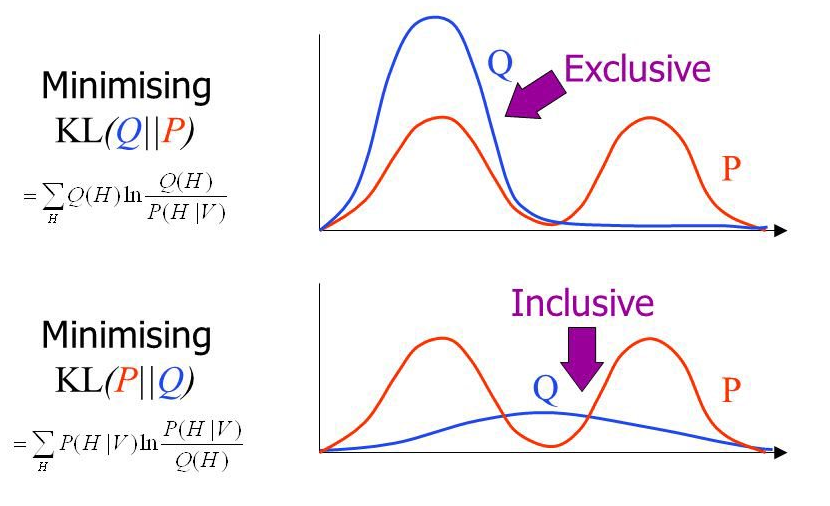 Figure by John Winn.
For an interactive version of this diagram where you can drag the modes around and watch both directions optimize in real time, see the interactive KL divergence fitting post.
Computational Perspective
Let's look at what's involved in fitting a model $q_\theta$ in each direction. In this section, I'll describe the gradient and pay special attention to the issue of normalization.
Notation: $p,q_\theta$ are probability distributions. $p = \bar{p} / Z_p$, where $Z_p$ is the normalization constant. Similarly for $q_\theta$.
The Easy Direction $\textbf{KL}(q_\theta || p)$
\begin{align*} \textbf{KL}(q_\theta || p) &= \sum_d q_\theta(d) \log \left( \frac{q_\theta(d)}{p(d)} \right) \\ &= \sum_d q_\theta(d) \left( \log q_\theta(d) - \log p(d) \right) \\ &= \underbrace{\sum_d q_\theta(d) \log q_\theta(d)}_{-\text{entropy}} - \underbrace{\sum_d q_\theta(d) \log p(d)}_{\text{cross-entropy}} \\ \end{align*}
Let's look at normalization of $p$, the entropy term is easy because there is no $p$ in it. \begin{align*} \sum_d q_\theta(d) \log p(d) &= \sum_d q_\theta(d) \log (\bar{p}(d) / Z_p) \\ &= \sum_d q_\theta(d) \left( \log \bar{p}(d) - \log Z_p \right) \\ &= \sum_d q_\theta(d) \log \bar{p}(d) - \sum_d q_\theta(d) \log Z_p \\ &= \sum_d q_\theta(d) \log \bar{p}(d) - \log Z_p \end{align*}
In this case, $-\log Z_p$ is an additive constant, which can be dropped because we're optimizing.
This leaves us with the following optimization problem: \begin{align*} & \underset{\theta}{\text{argmin}}\, \textbf{KL}(q_\theta || p) \\ &\qquad = \underset{\theta}{\text{argmin}}\, \sum_d q_\theta(d) \log q_\theta(d) - \sum_d q_\theta(d) \log \bar{p}(d) \end{align*}
Let's work out the gradient \begin{align*} & \nabla_\theta\left[ \sum_d q_\theta(d) \log q_\theta(d) - \sum_d q_\theta(d) \log \bar{p}(d) \right] \\ &\qquad = \sum_d \nabla_\theta \left[ q_\theta(d) \log q_\theta(d) \right] - \sum_d \nabla_\theta\left[ q_\theta(d) \right] \log \bar{p}(d) \\ &\qquad = \sum_d \nabla_\theta \left[ q_\theta(d) \right] \left( 1 + \log q_\theta(d) \right) - \sum_d \nabla_\theta\left[ q_\theta(d) \right] \log \bar{p}(d) \\ &\qquad = \sum_d \nabla_\theta \left[ q_\theta(d) \right] \left( 1 + \log q_\theta(d) - \log \bar{p}(d) \right) \\ &\qquad = \sum_d \nabla_\theta \left[ q_\theta(d) \right] \left( \log q_\theta(d) - \log \bar{p}(d) \right) \\ &\qquad = \mathbb{E}_{q_\theta}\!\left[ \left( \log q_\theta(d) - \log \bar{p}(d) \right) \nabla_\theta \log q_\theta(d) \right] \end{align*}
We killed the one in the second-to-last equality because $\sum_d \nabla_\theta \left[ q_\theta(d) \right] = \nabla_\theta \left[ \sum_d q_\theta(d) \right] = \nabla_\theta \left[ 1 \right] = 0$, for any $q_\theta$ which is a probability distribution. The last step applies the log-gradient trick, $\nabla_\theta q_\theta(d) = q_\theta(d)\, \nabla_\theta \log q_\theta(d)$, to write the gradient as an expectation under $q_\theta$.
This direction is convenient because we don't need to normalize $p$. Unfortunately, the "easy" direction is nonconvex in general—unlike the "hard" direction, which (as we'll see shortly) is convex.
When $q_\theta$ is in the exponential family, $\nabla_\theta \log q_\theta(d) = \phi_q(d) - \mathbb{E}_{q_\theta}[\phi_q]$. Substituting into the gradient above gives
\begin{align*} & \mathbb{E}_{q_\theta}\!\left[ \left( \log q_\theta(d) - \log \bar{p}(d) \right) \left(\phi_q(d) - \mathbb{E}_{q_\theta}[\phi_q]\right) \right] \\ &\qquad = \text{Cov}_{q_\theta}\!\left[\phi_q,\; \log q_\theta - \log \bar{p}\,\right] \\ &\qquad = \text{Cov}_{q_\theta}\!\left[\phi_q,\; \log (q_\theta / p)\right] \end{align*}
where the last step uses the fact that $\log \bar{p}$ and $\log p$ differ by the constant $\log Z_p$, which drops out of the covariance. In other words, this gradient is invariant to whether $p$ is normalized or not. Setting it to zero gives the optimality condition, residual orthogonality:
$$\text{Cov}_{q_\theta}\!\left[\phi_q,\; \log(q_\theta/p)\right] = 0$$
The log-density ratio $\log(q_\theta/p)$ must be uncorrelated with the sufficient statistics under $q_\theta$. No feature can predict whether $q_\theta$ is over- or under-estimating $p$—if one could, the optimizer would exploit it to further reduce the KL.
Harder Direction $\textbf{KL}(p || q_\theta)$
\begin{align*} \textbf{KL}(p || q_\theta) &= \sum_d p(d) \log \left( \frac{p(d)}{q_\theta(d)} \right) \\ &= \sum_d p(d) \left( \log p(d) - \log q_\theta(d) \right) \\ &= \sum_d p(d) \log p(d) - \sum_d p(d) \log q_\theta(d) \\ \end{align*}
Clearly the first term (entropy) won't matter if we're just trying to optimize wrt $\theta$. So, let's focus on the second term (cross-entropy). \begin{align*} \sum_d p(d) \log q_\theta(d) &= \frac{1}{Z_p} \sum_d \bar{p}(d) \log \left( \bar{q}_\theta(d)/Z_{q_\theta} \right) \\ &= \frac{1}{Z_p} \sum_d \bar{p}(d) \left( \log \bar{q}_\theta(d) - \log Z_{q_\theta} \right) \\ &= \left(\frac{1}{Z_p} \sum_d \bar{p}(d) \log \bar{q}_\theta(d)\right) - \left(\frac{1}{Z_p} \sum_d \bar{p}(d) \log Z_{q_\theta}\right) \\ &= \left(\frac{1}{Z_p} \sum_d \bar{p}(d) \log \bar{q}_\theta(d)\right) - \left( \log Z_{q_\theta} \right) \left( \frac{1}{Z_p} \sum_d \bar{p}(d)\right) \\ &= \left(\frac{1}{Z_p} \sum_d \bar{p}(d) \log \bar{q}_\theta(d)\right) - \log Z_{q_\theta} \end{align*}
The gradient, when $q_\theta$ is in the exponential family, is intuitive:
\begin{align*} \nabla_\theta \left[ \frac{1}{Z_p} \sum_d \bar{p}(d) \log \bar{q}_\theta(d) - \log Z_{q_\theta} \right] &= \frac{1}{Z_p} \sum_d \bar{p}(d) \nabla_\theta \left[ \log \bar{q}_\theta(d) \right] - \nabla_\theta \log Z_{q_\theta} \\ &= \frac{1}{Z_p} \sum_d \bar{p}(d) \phi_q(d) - \mathbb{E}_{q_\theta} \left[ \phi_q \right] \\ &= \mathbb{E}_p \left[ \phi_q \right] - \mathbb{E}_{q_\theta} \left[ \phi_q \right] \end{align*}
Setting this to zero gives the optimality condition, known as moment matching:
$$\mathbb{E}_p \left[ \phi_q \right] = \mathbb{E}_{q_\theta} \left[ \phi_q \right]$$
The expected sufficient statistics under $q_\theta$ must equal those under $p$.
Why do we say this is hard to compute? Well, for most interesting models, we can't compute $Z_p = \sum_d \bar{p}(d)$. This is because $p$ is presumed to be a complex model (e.g., the real world, an intricate factor graph, a complicated Bayesian posterior). If we can't compute $Z_p$, it's highly unlikely that we can compute another (nontrivial) integral under $\bar{p}$, e.g., $\sum_d \bar{p}(d) \log \bar{q}_\theta(d)$.
Nonetheless, optimizing KL in this direction is still useful. Examples include: expectation propagation, variational decoding, and maximum likelihood estimation. In the case of maximum likelihood estimation, $p$ is the empirical distribution, so technically you don't have to compute its normalizing constant, but you do need samples from it, which can be just as hard to get as computing a normalization constant.
Optimization problem is convex when $q_\theta$ is an exponential family—i.e., for any $p$ the optimization problem is "easy." You can think of maximum likelihood estimation (MLE) as a method which minimizes KL divergence based on samples of $p$. In this case, $p$ is the true data distribution! The first term in the gradient is based on a sample instead of an exact estimate (often called "observed feature counts"). The downside, of course, is that computing $\mathbb{E}_p \left[ \phi_q \right]$ might not be tractable or, for MLE, require tons of samples.
Remarks
-
In many ways, optimizing exclusive KL makes no sense at all! Except for the fact that it's computable when inclusive KL is often not. Exclusive KL is generally regarded as "an approximation" to inclusive KL. The bias in this approximation can be quite large.
-
Inclusive vs. exclusive is an important distinction: Inclusive divergences require $q_\theta > 0$ whenever $p > 0$ (i.e., no "false negatives"), whereas exclusive divergences favor a single mode (i.e., only a good fit around that mode).
-
When $q_\theta$ is an exponential family, $\textbf{KL}(p || q_\theta)$ will be convex in $\theta$, no matter how complicated $p$ is, whereas $\textbf{KL}(q_\theta || p)$ is generally nonconvex (e.g., if $p$ is multimodal).
-
Computing the value of either KL divergence requires normalization. However, in the "easy" (exclusive) direction, we can optimize KL without computing $Z_p$ (as it results in only an additive constant difference).
-
Both directions of KL are special cases of $\alpha$-divergence. For a unified account of both directions consider looking into $\alpha$-divergence.
Acknowledgments
I'd like to thank the following people:
-
Ryan Cotterell for an email exchange which spawned this article.
-
Jason Eisner for teaching me all this stuff.
-
Florian Shkurti for a useful email discussion, which caught a bug in my explanation of why inclusive KL is hard to compute/optimize.
-
Sabrina Mielke for suggesting the "inclusive vs. exclusive" figure.